

Here is some content about social learning in remote working. Quite a long post, but such an interesting topic. Social learning was present when I did an excellent remote working related course: Oyster®, Remote Working certification course – https://www.oysterhr.com/academy/remote-ready-certification.
I did some reflecting after completing the course and here are my thoughts. The best social learning culture happens in the best remote company culture if the things listed below are taken care of:
- Information is available regardless of time and place.
- Everything is transparent.
- People share and document just about everything.
- Work-related and informal social interactions happen all the time at work. It’s encouraged and enabled to be active and spend time building relationships.
- A feedback culture is strong.
- Everyone’s voice can be heard because of the different ways of collaborating and communicating with each other asynchronously and synchronously.
- Remote working culture and practices are intentionally built, implemented, and developed continually.
So people can learn from each other effectively and at all times. It’s a big factor in building a successful company and powerful results with engaged, productive, and happy employees.
Oyster is one of today’s best examples of a distributed remote company where a social learning culture is strong. So it’s amazing to see a fully working global remote company culture. It just works. So can you!
What is social learning in the remote workplace?
In today’s digital world, things are changing fast, and we have lots of information around us. So, people need to keep learning about new stuff and adapting to it. If organizations don’t keep up, they might fall behind. To stay in the game, organizations need to make learning a big deal. Companies should build a culture where workers feel OK trying new things, even if things don’t always work out. Social learning is a key to building this culture, allowing employees to share knowledge and learn from peers’ experiences, making it more personalized and effective than traditional training.
Social learning in the remote workplace is learning from others by watching them, doing what they do, and working together. It can happen in many ways, such as through online conversations, video meetings, documentation, and helping each other out on projects.
Social learning is important for remote workers because it can help them:
- Stay connected with their coworkers and learn from their experiences
- Learn new things and improve their skills
- Solve problems and overcome challenges
- Build relationships and trust between the team members
Creating a supportive and collaborative environment is essential for effective social learning, particularly for remote workers. Remote workers can feel disconnected from their colleagues and the organization’s collective knowledge. Social learning can help them bridge the gap, access valuable insights from their peers, and develop their skills and knowledge in a remote setting, ultimately enhancing remote workers’ job satisfaction and performance.
Here are some examples of social learning in the remote workplace:
- A new employee watches a more experienced coworker give an online presentation and learns from their techniques.
- A team of employees works together online on a project and shares their ideas and feedback with each other.
- A group of employees attends a virtual workshop on a new program.
- An employee asks a question in an online forum and receives helpful answers from their coworkers.
- A manager gives online feedback and coaching to an employee on their work.
According to Howspace (more about Howspace below), to excel in implementing social learning within the organization, the focus should be on these three components:
- Mindset Shift: Change the perspective on learning, emphasizing it as an individual’s lifelong journey rather than a one-time event, focusing on building lasting capabilities and behaviors.
- Leadership Transformation: Shift from authoritative leadership to a coaching approach, where leaders support employees in finding resources and connections within self-organizing groups, promoting growth and well-being.
- Technology Integration: Embrace collaborative learning technologies like Howspace’s social learning platform to break down organizational barriers, enabling employees to create and nurture communities of practice for knowledge-sharing and skill development.
How can you promote a social learning culture in a remote company?
Here are a few tips about this:
- Create a dedicated space for social learning. This could be an online community, forum, or channel where employees can ask questions, share resources, and discuss ideas. Tools like Slack, Microsoft Teams, Howspace, etc. can be great for this.
- Encourage peer-to-peer learning. This could be done through mentoring, coaching, shadowing, or peer review.
- Organize virtual events and workshops. This is a great way for employees to learn from each other and from experts outside the company. Tools like Zoom, Google Meet, Howspace, etc. can be used to host these events.
- Promote social learning in team meetings and one-on-ones. Encourage employees to share their learning experiences and insights with each other. Different platforms and tools can help facilitate this.
- Celebrate learning and development. Recognize employees for their learning achievements and encourage them to share their knowledge with others.
- Make it easy for employees to participate in social learning. Provide clear instructions on how to access and use the tools and resources that support social learning.
- Create a culture of psychological safety. Employees should feel comfortable sharing their ideas and learning experiences. Making a mistake is not a problem – on the contrary, we learn best from mistakes, so let’s start sharing them!
- Lead by example. Managers and leaders should be active participants in social learning. Share your own learning experiences and insights with your team members.
Howspace – one specific platform to enhance the social learning culture
There are many platforms that support social learning, and it’s up to the organization how they enhance social learning culture and practices in their platform. I’ll present shortly one innovative option – the Howspace platform.
I’ve come across the Howspace platform on many occasions. It is a Finnish product (like me 😊), that has a unique approach, design, and tools (like me 😄).
Howspace is a transformation and social learning platform that helps organizations facilitate social collaboration and learning. It provides a variety of features that support social learning, such as discussion forums, group projects, peer-to-peer feedback, AI, etc. Look at the platform features here (below photo source: howspace.com)
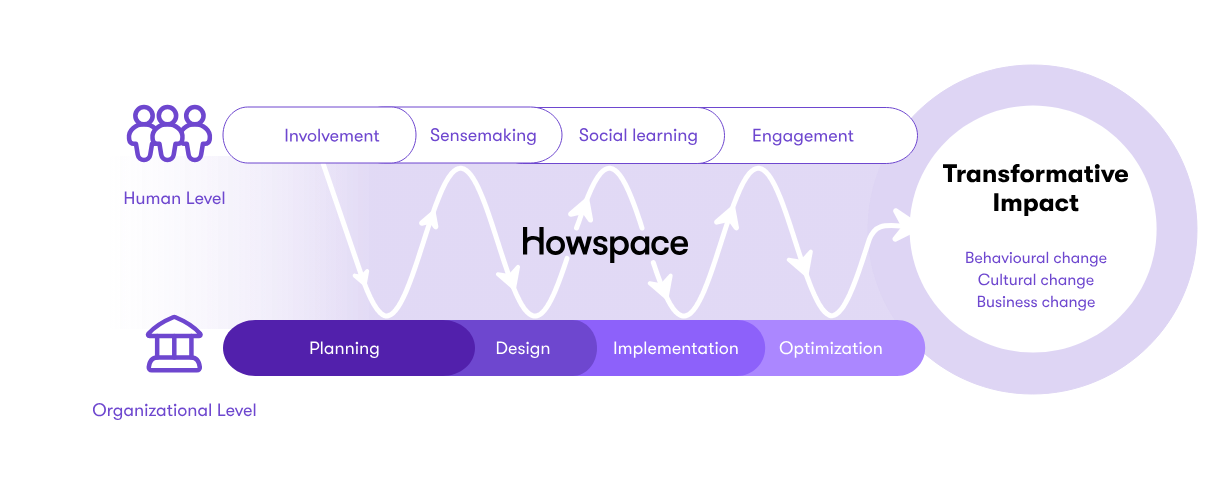
Howspace can be used to support a variety of social learning practices, such as:
- A company can use Howspace to build facilitator-led learning programs, such as leadership development or role-specific training programs. Howspace provides a dedicated workspace for each learning program, which includes tools for collaboration, discussion, and reflection.
- Howspace can support self-directed learning. Employees can use Howspace to find and share learning resources, collaborate on projects, and get feedback from peers.
- An organization can provide immediate on-the-job learning opportunities as employees can seek advice and support from colleagues when facing challenges. This approach enhances job relevance and cultivates communities of practice within the organization, where employees with shared interests or expertise collaborate and develop best practices. Howspace’s platform workflows, templates, and tools could provide versatile ways to support this to happen.
- A company can facilitate employee connections, knowledge sharing, and collaboration using Howspace, which lets employees participate in interest-based communities and groups, fostering peer-to-peer learning and keeping them informed about industry trends. Howspace’s use of social learning can nurture a culture of knowledge sharing and continuous learning throughout the company.
- A company could use Howspace to facilitate development programs. The programs could include activities such as discussion forums, group projects, and peer feedback. The participants could use Howspace to share their experiences, learn from each other, and develop new skills.
- A team could use Howspace to collaborate on a project. The team members could use Howspace to share ideas, discuss the project, and get feedback from each other. Howspace could also be used to manage the project and track progress.
- A mentor or a coach could use Howspace to communicate with their mentee/coachee. The mentor and mentee could use Howspace to share resources, discuss the mentee’s career goals, and get feedback from each other.
You can start to use Howspace for free (with limited tools and options), just sign in and you’re ready to go.
Resources used in this chapter:
📕 Social learning is the future of L&D — here’s why – https://howspace.com/blog/social-learning/
📕 The top 4 blended learning strategies that support social learning – https://howspace.com/blog/blended-learning-strategies-that-support-social-learning/
📕 8 leadership tools every business leader should be using – https://howspace.com/blog/leadership-tools/
📕 What is a Learning Experience Platform (LXP)? – https://howspace.com/blog/what-is-a-learning-experience-platform/
Read more about social learning in remote working
📕 What are some effective social learning strategies for remote teams? – https://www.linkedin.com/advice/0/what-some-effective-social-learning
📕 From Isolation to Collaboration: The Benefits of Incorporating Social Learning in Corporate Training – https://www.linkedin.com/pulse/from-isolation-collaboration-benefits-incorporating-social/
📕 How do you keep social learning engaging and relevant for staff? – https://www.linkedin.com/advice/1/how-do-you-keep-social-learning-engaging-relevant
📕 Remote Workplaces Need Continuous Learning Initiatives – https://www.togetherplatform.com/blog/continuous-learning
📕 How do you keep remote employees learning? – https://www.linkedin.com/advice/3/how-do-you-keep-remote-employees-learning
📕 How do you transfer learning in remote or hybrid work environments? – https://www.linkedin.com/advice/3/how-do-you-transfer-learning-remote-hybrid
📕 How do you use technology to encourage social learning? – https://www.linkedin.com/advice/1/how-do-you-use-technology-encourage-social-learning
Check also my other materials about
🔗 Knowledge osmosis – Foster a culture of passive learning in remote teams – https://www.goodhill.fi/rocktheremote/knowledge-osmosis-foster-a-culture-of-passive-learning-in-remote-teams/
🔗 Building a successful remote company – https://www.goodhill.fi/rocktheremote/building-successful-remote-company-culture/
🔗 Building remote company – https://www.goodhill.fi/rocktheremote/work/building/
🔗 Remote companies – https://www.goodhill.fi/rocktheremote/work/companies/
🔗 Remote playbooks/handbooks – https://www.goodhill.fi/rocktheremote/work/playbooks/